Localization Is an Architecture Problem: Building a Production-Grade i18n System with LangOS and Lingo.dev
February 22, 2026
 Ashish Gogula
February 22, 2026
Ashish Gogula
Most localization failures do not start in translation tooling. They start in product architecture.
What is Localization?
Localization is adapting software to different languages and regions.
It includes translated UI, right to left support, and locale aware formatting for dates and currency.
It is not just translation. It is architecture.
Teams hardcode strings in components, patch manual dictionaries per feature, skip RTL behavior because it can be handled later, and format money and dates with string concatenation. CI passes because it only checks lint and build. Then production users switch locale and the cracks show up.
Untranslated UI.
Inconsistent runtime behavior.
Broken RTL layouts.
Incorrect currency formatting.
Localization is rarely treated as infrastructure. It is treated as content editing.
For the Lingo.dev hackathon, I built LangOS to explore a different approach. Instead of demonstrating a language toggle, I designed a structured localization system with clear boundaries across build, runtime, UI direction, formatting, and CI.
This project is not a wrapper. It is not a SaaS. It is a reference architecture that shows how localization should be wired into a modern frontend application.
Browser translation tools are useful for rough comprehension. They are not a production localization strategy.
They do not enforce source and target locale contracts in your code. They do not integrate with your build pipeline, runtime API boundaries, or CI checks. They translate rendered output, not application state or structured UI copy.
Production localization requires deterministic artifacts, scoped direction handling, locale-aware formatting, and automated enforcement. That is what this project demonstrates.
LangOS is a structured localization playground built with Next.js and Lingo.dev.
The goal is simple: show how localization decisions are wired across the entire system.
Instead of proving that a button can change language, the project proves that:
A language toggle alone does not prove reliability. System design does.
The application is divided into clear localization layers.
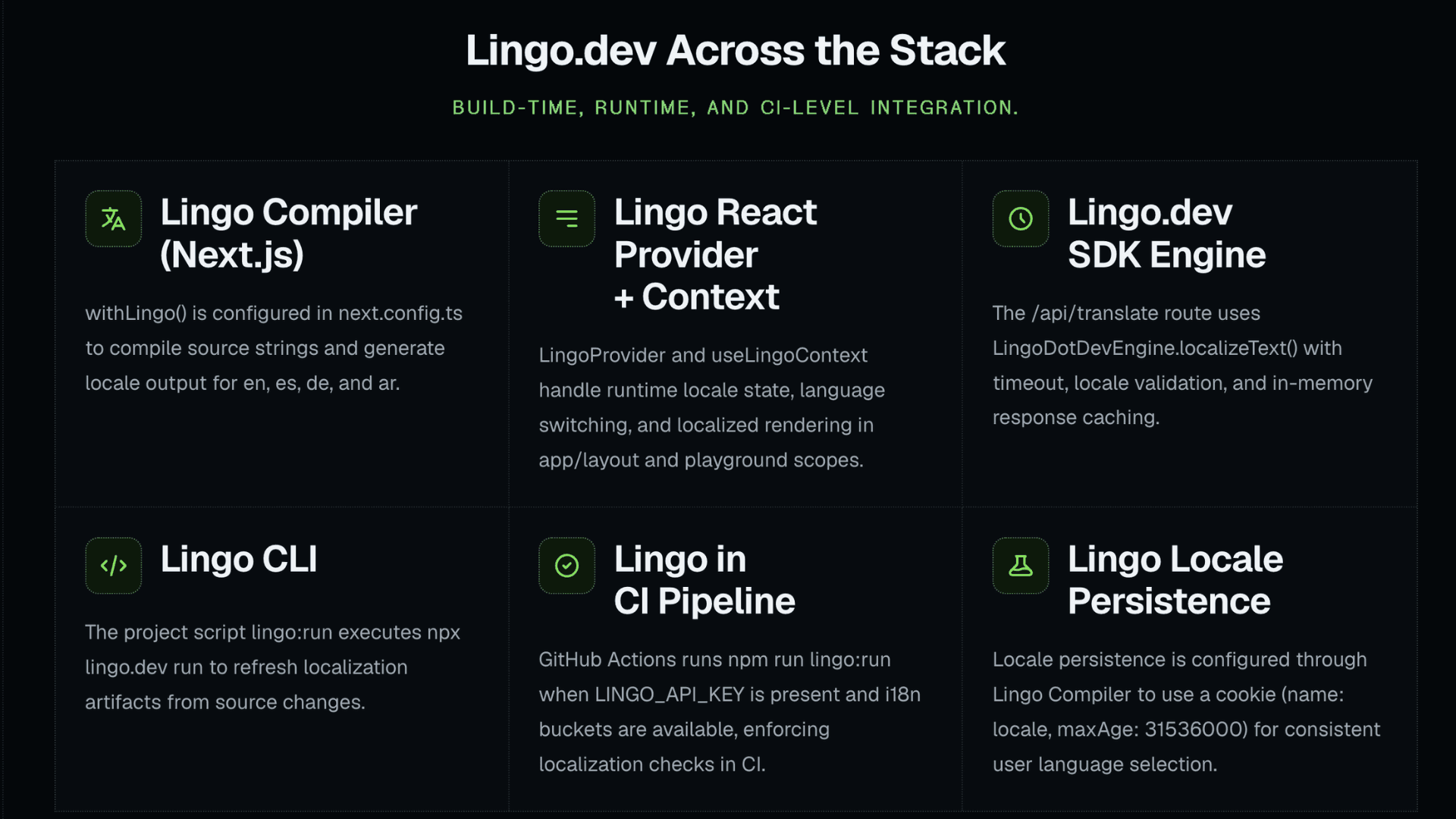
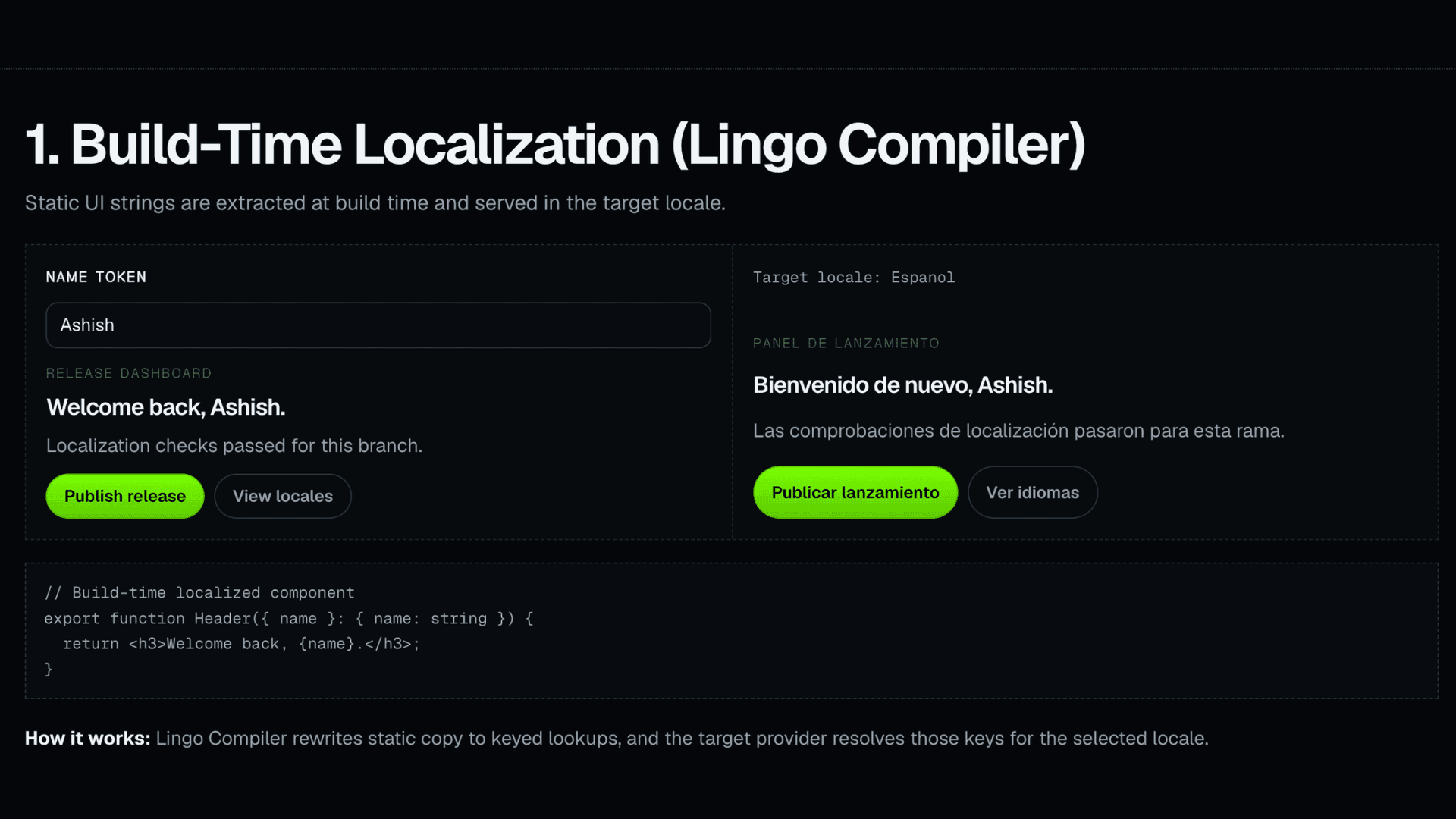
Static UI strings are compiled at build time using the Lingo compiler integration in next.config.ts.
The configuration defines:
Locale artifacts are generated as real JSON files, not placeholders. Static copy is stored as keyed entries and resolved through a scoped provider in the application.
This separates deterministic UI copy from dynamic user content. It makes releases predictable because static translations are baked into build artifacts.
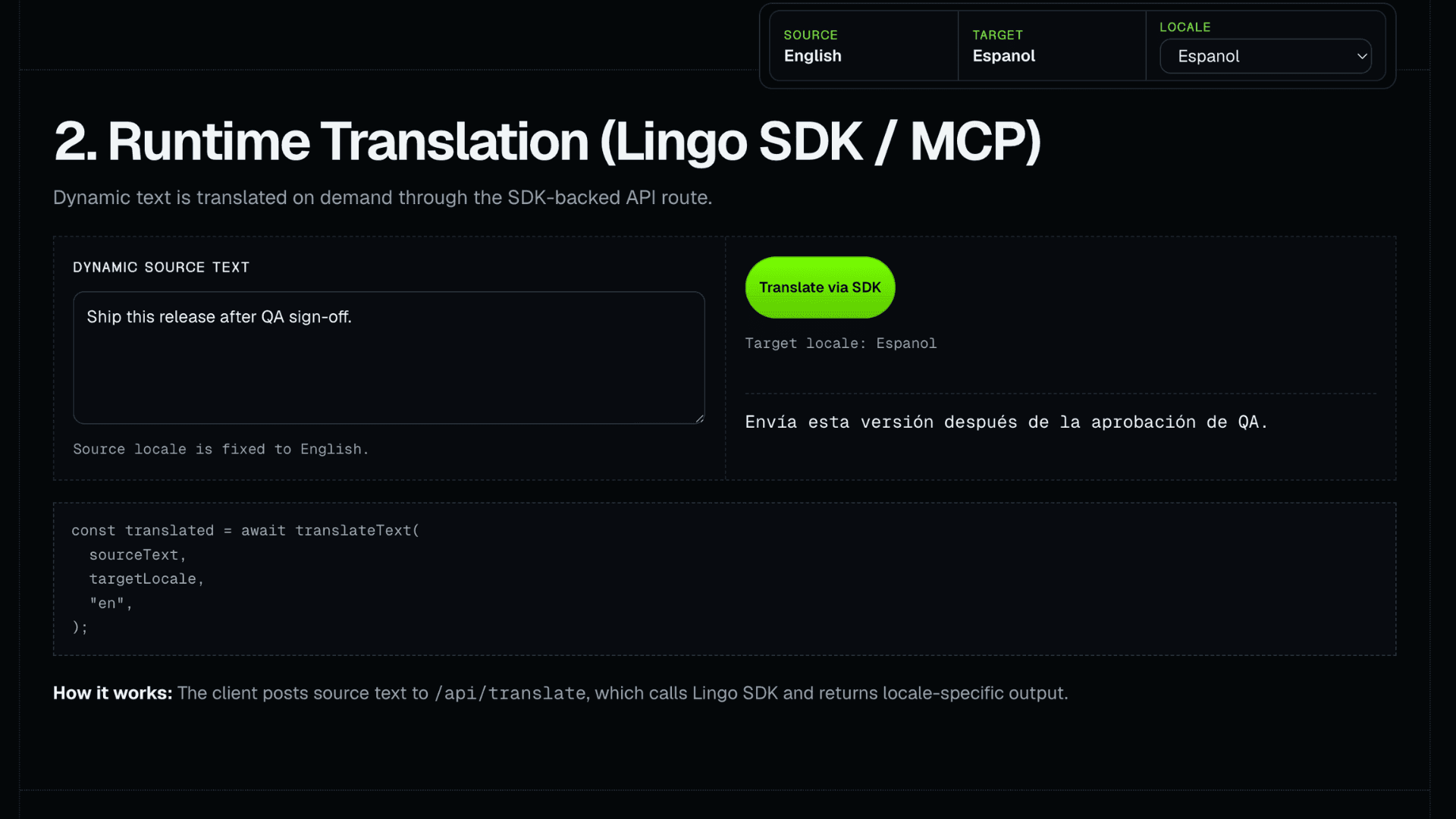
Dynamic text is handled through a typed API route.
The server route:
The client calls /api/translate using fetch with AbortController for timeout safety.
This isolates user-driven translation from build artifacts and introduces runtime validation and caching behavior.
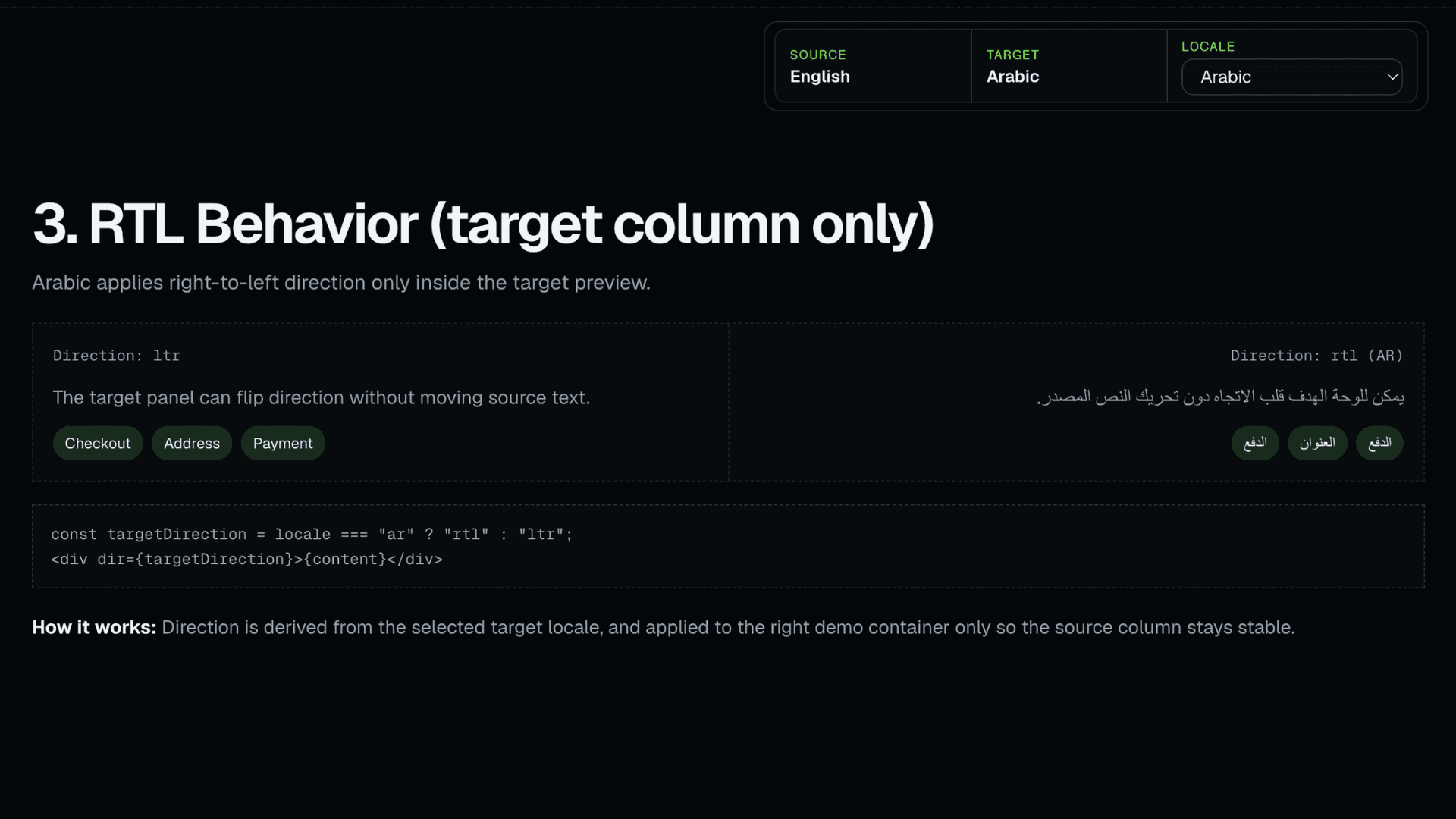
One of the key architectural decisions was scoping direction changes only to the target preview panel.
The source panel always renders with dir="ltr".
The target panel computes direction based on selected locale and applies dir="rtl" only when necessary.
This allows side-by-side comparison without flipping the entire page layout.
I intentionally avoided flipping the full document because I wanted architectural clarity, not visual gimmicks.
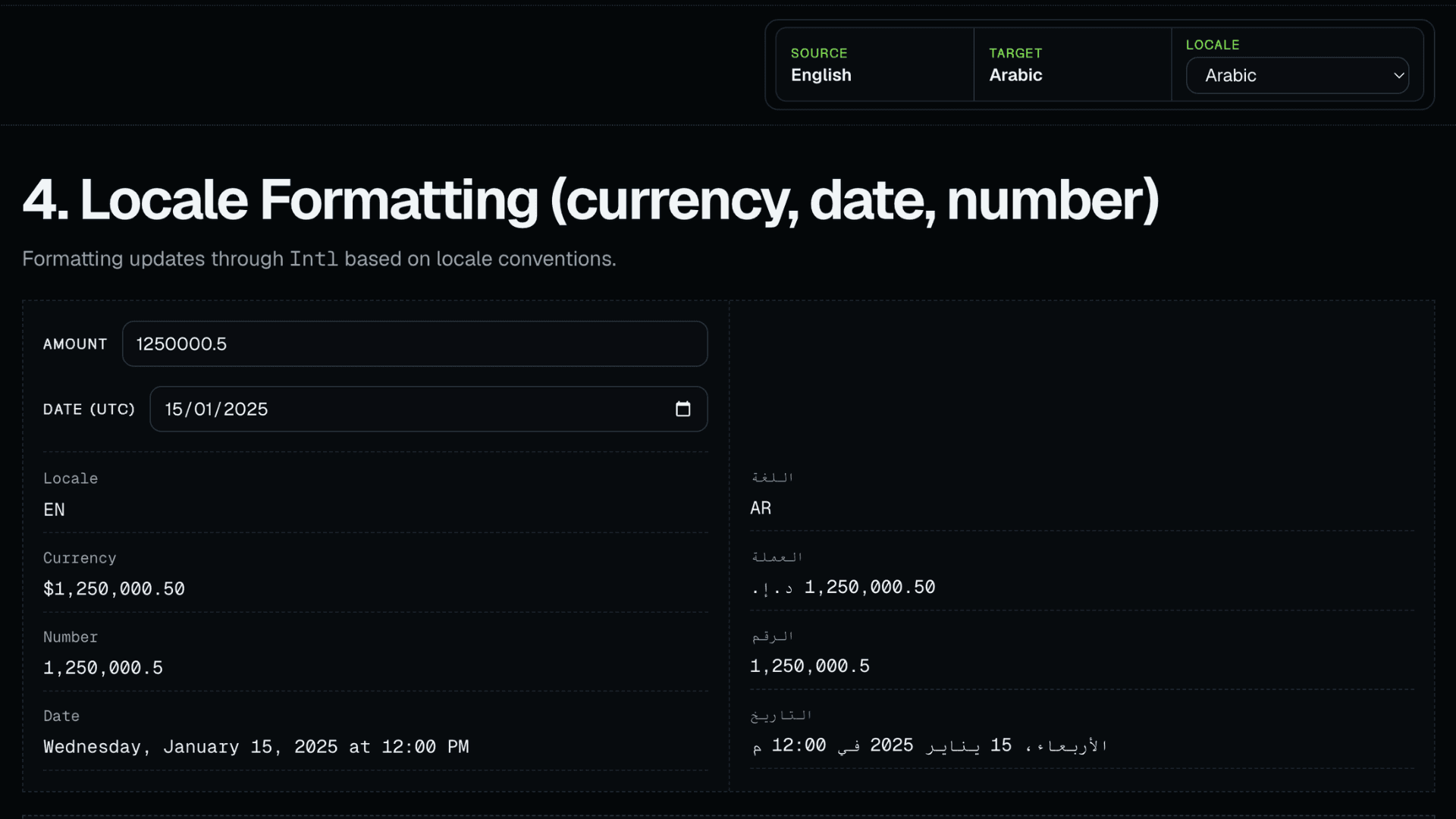
Localization is not just text translation. It includes numeric and temporal formatting.
The playground formats currency, numbers, and dates using the Intl API.
Examples include:
Currency mapping is derived from locale definitions:
This makes differences in grouping, symbol placement, and date ordering explicit and testable.
Localization becomes infrastructure when it is enforced in workflow.
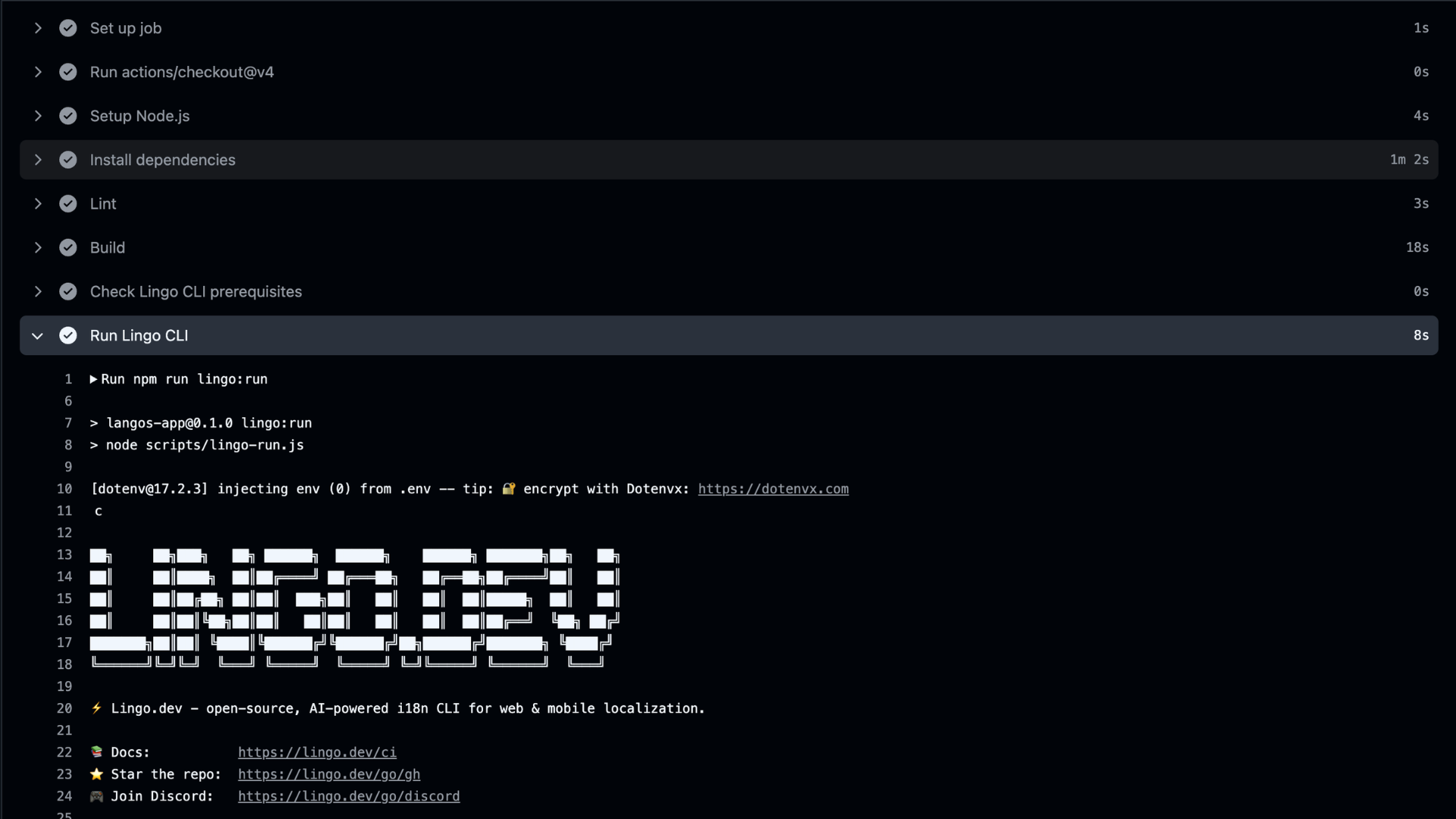
The project exposes npm run lingo:run, backed by a custom script that:
CI integration runs on push and pull requests. The workflow:
This makes localization automation explicit and auditable in the pipeline.
Localization stops being optional cleanup. It becomes part of delivery quality.
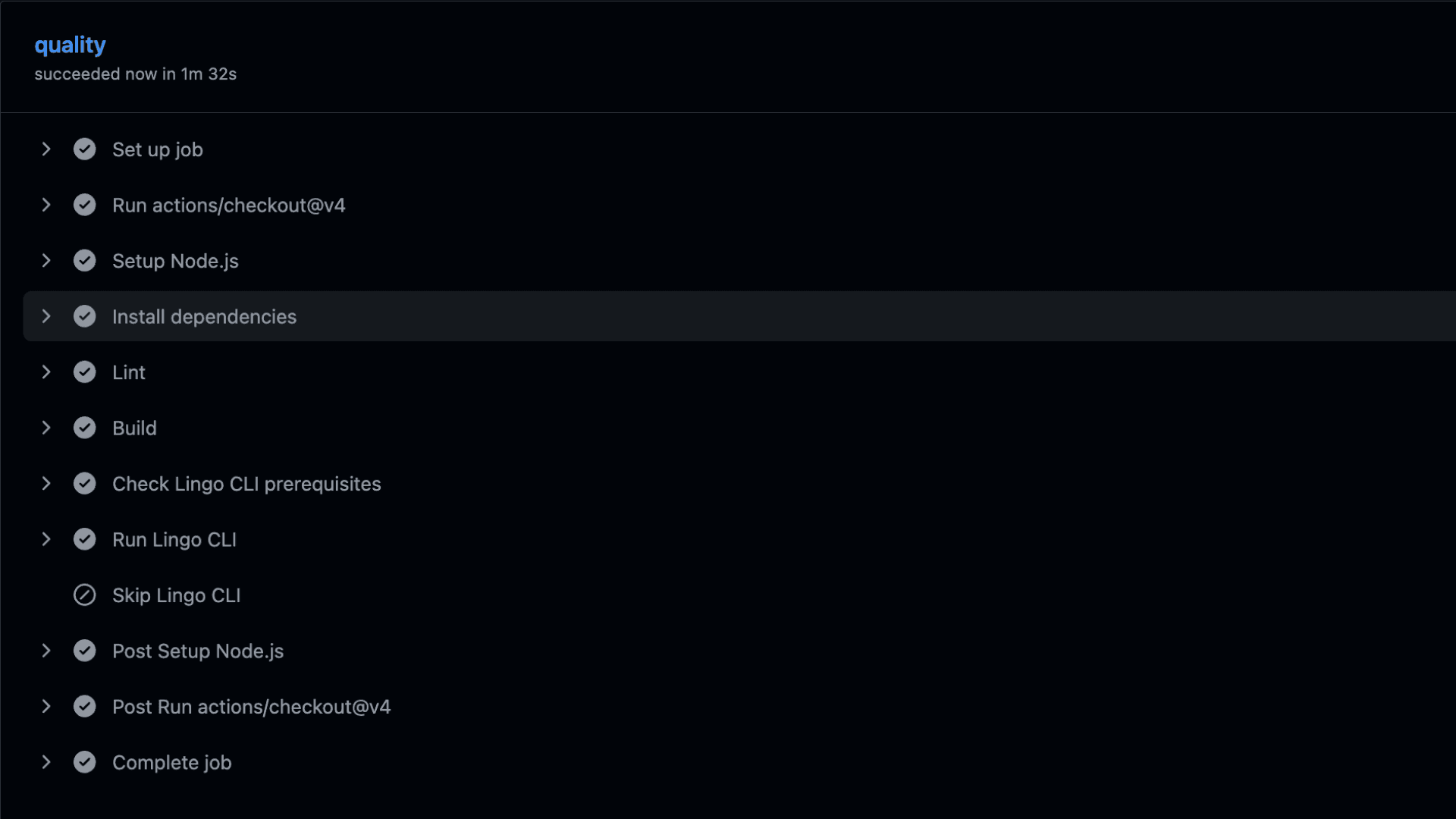
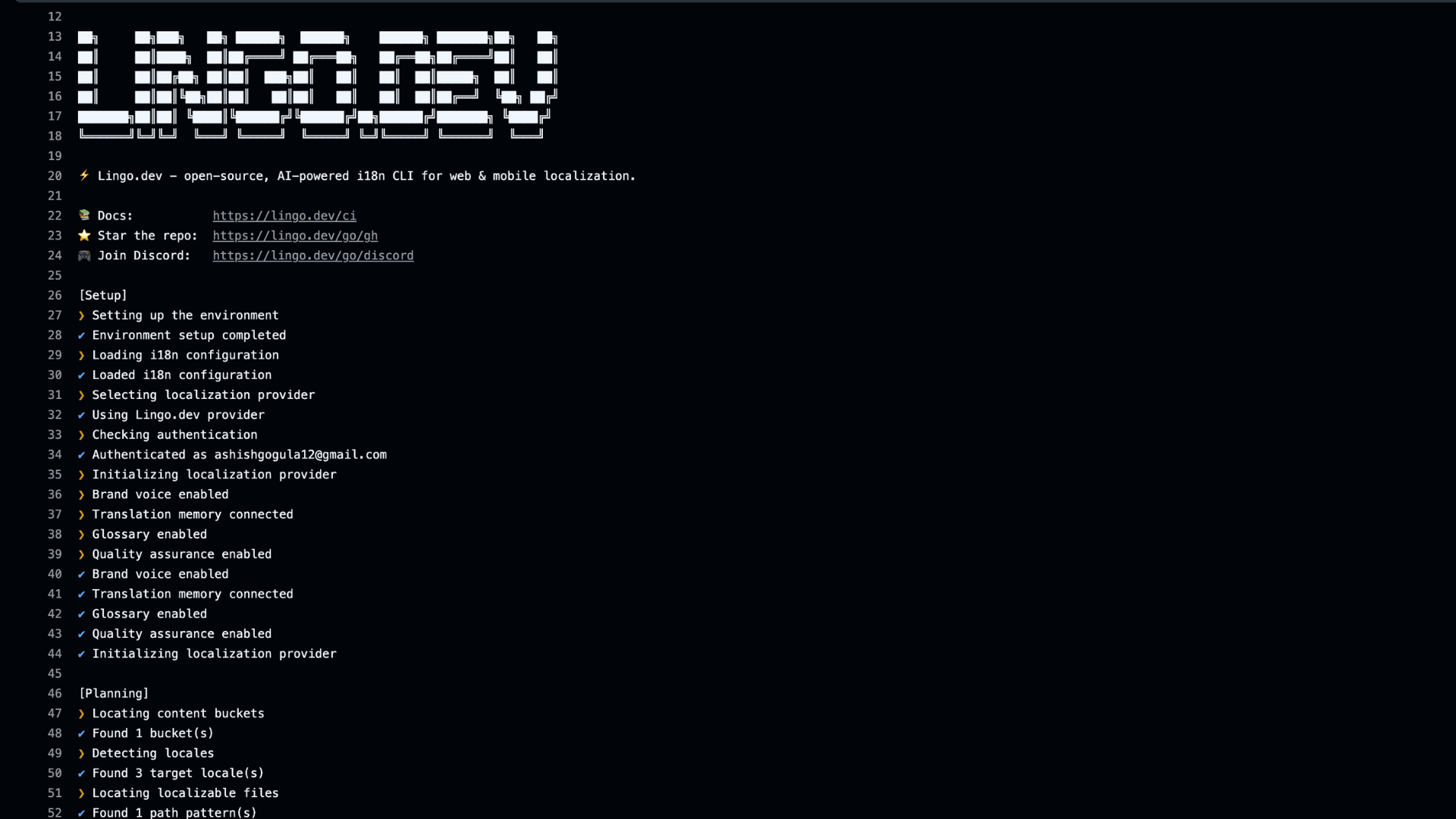
Automation is meaningless unless it is observable.
Live CI runs are publicly available:
https://github.com/ashishgogula/LangOS/actions (opens in new tab)
The playground renders English as the source of truth on the left and the selected target locale on the right.
Each demo section uses scoped providers so both panels render in parallel without interfering with each other.
This structure allows you to observe:
All inside one viewport.
I initially thought localization was mostly about swapping text. Building this forced me to think in boundaries and contracts instead.
The layout optimizes for architectural clarity over visual novelty.
Localization gets easier when it is treated as infrastructure rather than content editing.
The biggest shift was workflow discipline. Once localization was wired into scripts and CI, translation state became part of delivery quality. It was no longer something that could be postponed.
Separating build-time and runtime localization removed a common source of confusion. Static UI copy belongs in deterministic artifacts. User input and operational text belong in a runtime translation path with validation and timeout behavior.
Another lesson was UI boundary design. Scoped RTL and side-by-side rendering are practical tools for reducing regressions while teams iterate quickly.
Architecture clarity in localization is often underrated because translation is seen as a content task. In practice, reliability comes from contracts, boundaries, and automation.
Frontend engineers should care about this because localization bugs are rarely visual issues. They are systemic design issues.
This project was built using Lingo.dev, a developer focused localization toolkit that supports build time compilation, runtime translation, CLI automation, and CI integration. The goal of this hackathon project was to explore how Lingo can be integrated across the full application lifecycle rather than used as a simple translation utility.
LangOS is open source and publicly available. You can inspect the implementation, configuration, and CI workflow here:
Project repository:
https://github.com/ashishgogula/LangOS (opens in new tab)
Live demo:
http://langos.ashishgogula.in/ (opens in new tab)
Live CI runs:
https://github.com/ashishgogula/LangOS/actions (opens in new tab)
Localization is not about translating strings.
It is about designing systems that make global software reliable across build, runtime, rendering direction, formatting, and delivery workflow.
LangOS is a small project, but it demonstrates a larger idea. Localization should be part of architecture from day one.